The snake tree (Radermachera sinica syn. Stereospermum sinicum), also called China doll or emerald tree, is a small tree native to southern China and Taiwan where it grows up to 7 to 10m in height, in mountainous areas up to 900m above sea level. It remains quite cautious and fears the temperature falling below 0°C.
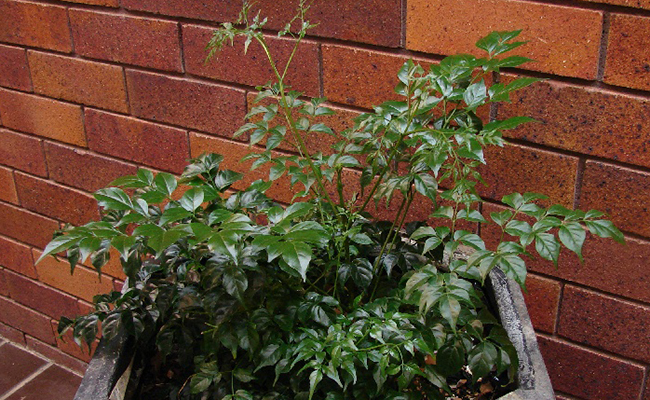
THE radermachera, with rapid growth, stands out for its erect, erect, spreading habit, whose very branched stems make it dense in foliage. Its opposite leaves, large (up to 70cm long), deep green, glazed, divided into small bipinnate leaflets, lanceolate, are persistent and appear almost leathery.
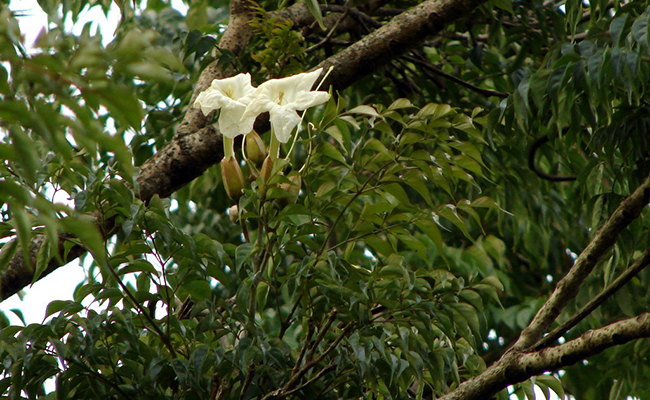
In its natural environment, terminal panicles of large, fragrant tubular flowers up to 10cm long, creamy white, are formed followed by fruiting in capsules 4-5cm long containing winged seeds, but no flowering occurs indoors .
It doesn’t matter, as a green indoor plant, its thick, shiny, light-looking foliage is enough to charm us…provided you don’t expose it to atmospheric pollution!
- Family: Bignoniaceae
- Type: evergreen houseplant
- Origin: China, Taiwan
- Color: shiny green leaves
- Sowing: yes
- Cutting: yes
- Planting: spring
- Flowering: summer
- Height: up to 1.5 m (10m in its natural environment)
Ideal soil and exposure for the snake tree
Radermachera sinica grows in a light situation but without direct sun, sheltered from drafts, in a well-drained pot filled with horticultural compost. It accepts the usual temperature of housing well but appreciates spending the winter a little cooler (15-16°C) if possible.
Date of sowing, cutting and repotting of Radermachera sinica
Technically, sowing can be done in the spring between 19 and 24°C, but as the plant does not grow indoors, you will not have seeds.
Cutting herbaceous stems at the end of spring or semi-woody stems in August-September remains a good alternative: stewed, keeping the substrate moist, you should see a recovery fairly quickly.
Repotting is planned in the spring every year or every two years depending on the growth of the Radermachera sinica.
Board of maintenance and culture of Radermachera sinica
The radermachera has the advantage of being easy to grow and quite robust. Regular waterings are necessary in order to keep the substratum humid during the growth period; in winter, it will be necessary to space them and let the substratum dry up between two waterings. Spraying the foliage with non-calcareous water is an advantage.
So that the Radermachera sinica retains its compact and bushy habit, pruning is essential, in the spring, by pinching the stems so that they branch out.
From spring until the end of summer, the Radermachera can be installed outside, sheltered from the scorching sun and the wind.
Diseases, pests and parasites of Radermachera sinica
Radermachera sinica It is not too sensitive to diseases or attacks by parasites, although mealybugs, spider mites or aphids can attack it.
Location and favorable association of Radermachera sinica
It is a plant that is grown in a bright room, in front of a window facing east or west.
Recommended species and varieties of Radermachera for indoors
Genre Radermachera has about 15 species and owes its name to the Dutch botanist, Jacob Radermacher (1741-1783) who did much for the discovery of plants in Indonesia via the Dutch East India Company. The snake tree (Radermachera sinica) represents the genus among nurseries and garden centers that only offer this species.
(photo credit: Tatters ✾ – CC BY 2.0)