The stromanth (stromanthe sanguinea), also called peacock plant, is a rhizomatous perennial plant originating from the tropical forest areas of South America and which we can only cultivate as a houseplant in our latitudes since it fears the cold and requires at least 10°C .
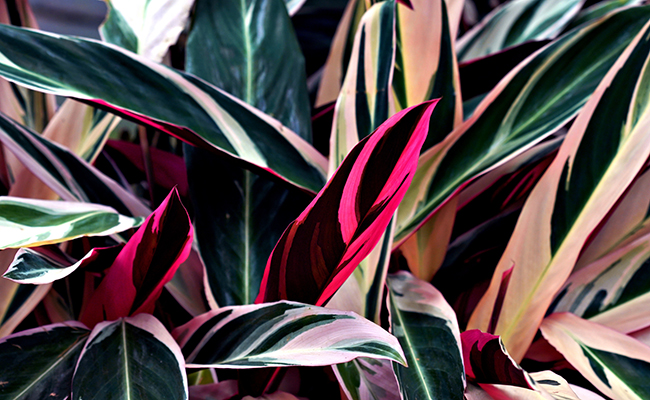
Its major asset lies in its remarkable colorful foliage flooded with shades of pink, red, green, cream, creating irregular and unusual patterns.
Its upright, branched, tufted stems give it an upright habit. Large leaves 30 to 50cm long, persistent, linear, lanceolate, oblong, display, in stromanthe sanguineaan olive-green color splashed with cream above, with a red to purple reverse.
Perhaps you will be lucky enough to see it bloom in winter or spring, or even any time of the year if you grow this stromanth in a greenhouse? In this case, you will discover panicles 6-8cm wide, made up of flowers up to 1cm long whose petals are white but the sepals are red, as are the bracts that surround them.
Even deprived of flowering, you will appreciate the decorative foliage of the stromanthe sanguinea which is reminiscent of that of Ctenanthe And Calathea which belong to the same botanical family.
- Family: Marantaceae
- Type: evergreen houseplant
- Origin: South America
- Color: green leaves spotted with pink, cream, red
- Sowing: yes
- Cutting: no
- Planting: spring
- Flowering: all year round but rare
- Height: 0.45 m to 1 m (up to 1.5 m in its natural environment)
Ideal soil and exposure for Stromanthe
Stromanthus must enjoy bright light, sheltered from direct sunlight and drafts, in a warm environment of 19-22°C and high humidity. Choose a well-draining substrate made up of potting soil, heather and bark, to fill its pot, which you will place on a saucer lined with clay balls or gravel.
Date of sowing, dividing and repotting the Stromanthe
At the end of winter, you will sow the seeds, if you find any, in a sandy mixture, at 18°C.
The division of the clumps, in the spring, makes it possible to multiply the stromanthus much more effectively by taking great care of the fragile roots.
Repotting takes place in the spring when the plant is cramped: every 1 to 3 years, depending on the situation.
Stromanthe Care and Cultivation Board
The substrate must always remain slightly damp but never soaked and ensuring that the pot does not bathe in water but is on the bed of clay balls or gravel of the saucer. To increase the hygrometry, the daily spraying of the leaves is still recommended, with non-calcareous water.
Damaged or dried out leaves can be cut off at the base.
Diseases, pests and parasites of Stromanthe
Stromanths are susceptible to attacks by spider mites and scale insects when the atmosphere is too dry.
Location and favorable association of the Stromanthe
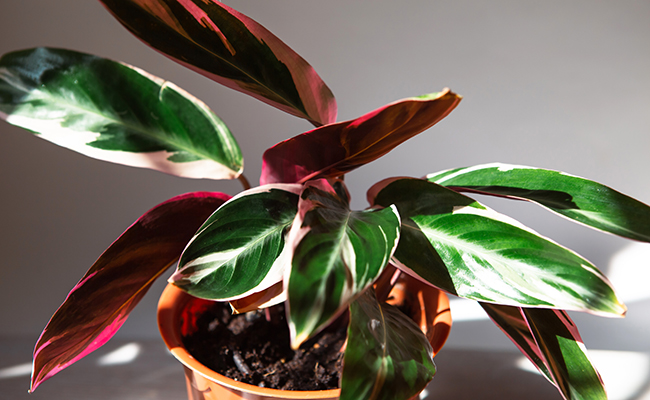
It is an indoor plant that will find its place in a room whose window or bay window faces north or east, if possible a bathroom or a kitchen, water features by nature.
Recommended species and varieties of Stromanthe for planting in the garden
Genre Stromanthus counts a dozen species in total among which the most remarkable is stromanthe sanguinea with its leaves above olive green splashed with cream and its reverse red to purple. Its cultivar ‘Triostar’ has green, cream and pink leaves.
Stromanthe jacquinii has darker green leaves and grows taller (up to 2m).