The wig tree (Cotinus coccygria) also commonly known as fustet, Jupiter’s beard or even smoke tree, is a bushy shrub which inherited this name because at the time of flowering, its pedicels form a vaporous and feathery hair reminiscent of the shape of a wig. Its hardiness (-20°C) allows it to face the harsh winters of northern France.
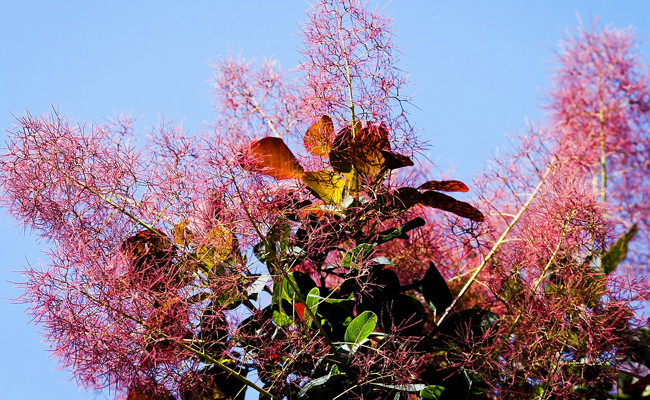
Its deciduous, alternate leaves, 5 to 7cm long, oval, light green, change beautifully, depending on the season, from yellow to orange, then to red once autumn comes.
In summer, its tiny flowers gathered in filamentous, feathery panicles, 7 to 15cm long, are melliferous and attract bees. Their green color evolves towards powdery pink when ripe. These inflorescences are very decorative even when they are dried. In September, small brown ovoid fruits follow the flowering.
The wig tree is poisonous, especially its fruits and leaves. The same is also true of the sap flowing from its branches, which is very irritating to the skin. Children should be kept away from this shrub and especially from its fruits.
Cotinus coccygria is highly recommended as a hedge for its very ornamental side, despite its tall height which reaches up to five to six meters.
- Family : Anacardiaceae
- Kind : deciduous shrub
- Origin : Eurasia
- Color : powdery pink flowers, purplish pink
- Sowing: Yes
- Cutting: Yes
- Planting: spring or fall
- Bloom : May to September
- Height : 3 to 6 meters
Ideal soil and exposure for planting a wig tree in the garden
With exposure to the sun or in a semi-shaded place, the wig tree is content with any type of well-drained soil, even poor and calcareous but above all not clayey. It supports episodes of heat, drought, windy situations, and even increasingly frequent air pollution.
Date of multiplication and planting of Cotinus coccygria
As Jupiter’s beard is difficult to propagate by seed, other methods of propagation will be preferred, such as layering in March or cuttings of herbaceous stems in June.
Planting is planned from April to May or from November to December.
Board of maintenance and culture of the wig tree
Once properly installed, your Cotinus coggygria will withstand very well the strong heat, but also the strong frosts. It therefore does not need winter protection.
This ornamental shrub does not require particular maintenance, except, possibly, pruning, in February-March, intended to keep it compact and decorative with more developed leaves. Over the years, if the stems become bald, be aware that the Cotinus supports severe pruning, even coppicing.
Diseases, pests and parasites of Cotinus coccygria
The great enemy of the wig tree is humidity with verticillium wilt developing.
Location and favorable association of the wig tree
Cotinus coggygria is grown alone or in association, in a hedge, with other decorative shrubs such as forsythia and syringa. For installation in a container on the terrace and balcony, but also on the edge, in rockeries and in beds, it will be necessary to opt for varieties with low development.
Species and varieties of Cotinus recommended for planting in the garden
Only 2 species of the genus cotinus exist. The wig tree (Cotinus coggygria) is the most common, it has a few varieties like Cotinus coggygria ‘Rubrifolius’bushy with dark purple foliage and inflorescences, Cotinus coggygria ‘Royal Purple’with dark purple-red foliage turning scarlet in autumn, Cotinus coggygria ‘Flame’with flowers in purple-pink panicles and light green foliage turning brilliant red-orange with autumn, Cotinus coggygria ‘Notcutt’s Variety’ with wine-red foliage and purple-pink panicles, Cotinus coggygria ‘Young Lady’ with compact port (1.20m)…
Cotinus ‘Grace’ is a cultivar with purple leaves turning brilliant translucent red in late fall, bearing dusty pink flowers.
Cotinus obovatus is the other species which can reach 10m in height, it forms large feathery grey-pink panicles from June to October.