The achimene (Achimenes) is a small rhizomatous perennial native to the subtropical forests of Mexico and Central America, which fears the cold and needs a minimum of 10°C. As its interest lies in its abundant colorful flowering, it becomes, in our latitudes, an annual or an indoor plant, available in many hybrids. She looks a bit like impatience (Impatiens).
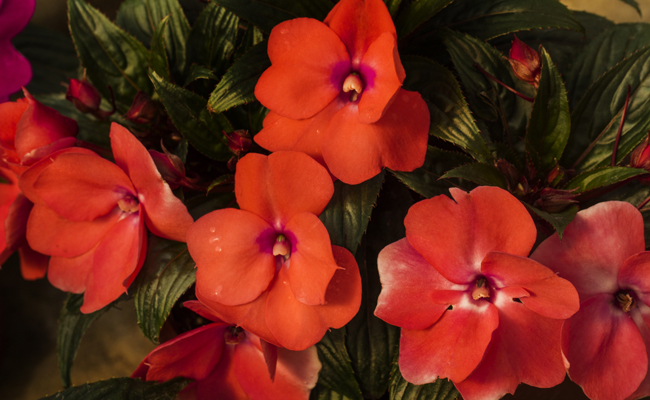
The erect and often branched stems arise from the scaly rhizomes, thus adopting a bushy, rounded or even drooping silhouette depending on the variety. These fragile and brittle stems carry deciduous leaves, simple, oval, opposite or whorled, finely toothed, measuring 6 to 8cm long, dark green, with the underside often reddish, otherwise light green.
From June to September, the achimenes are covered with small tubular flowers with 5 flattened petals, which appear in the axils of the leaves, and are renewed from the beginning of summer until the arrival of autumn, in colors varied: red, pink, white, purple blue, mauve, purplish blue, white veined with purple, yellow, etc.
Achimenes are often among the plants chosen by cities to flower the flowerbeds because of their floriferous interest throughout the beautiful season, also making it possible to vary the colors according to the flowerbeds.
- Family: Gesneriaceae
- Type: deciduous perennial grown as an annual
- Origin: Central America
- Colour: red flower, pink, white, blue, mauve, blue, white veined with purple, yellow…
- Sowing: no
- Cutting: yes
- Planting: spring
- Flowering: June to fall
- Height: 0.35 to 0.5 m (as much spread)
Ideal soil and exposure for the achimene
In the garden, the achimene is grown in partial shade or in filtered sun in a soil with an acid tendency, fresh and well drained.
In pots, the achimene appreciates a substrate composed of horticultural compost, heather soil and sand to promote good drainage, in addition to a good layer of gravel at the bottom. Its ideal place is in front of a window exposed to the east or further back in a south-facing space so as not to suffer the scorching rays of the sun.
Date of division, cuttings and planting of achimene
It is in the spring that you can proceed to the multiplication of the achimene, either by dividing the rhizomes, or by cuttings of stems placed in a hot suffocation.
Planting is done in the spring, either from February-March, for indoor pot culture, or in April-May, when the risk of frost has passed, for installation in the garden. The rhizomes must be buried by 3 or 4cm, and grouped by 3 to 6 to create a more striking bushy effect.
Council of maintenance and culture of the achimene
Watering must be regular, especially during the growth period, but without letting water stagnate in the saucer, which will simply be lined with clay balls or gravel.
In autumn, when flowering dries up, and before the cold weather arrives, it is possible to recover the rhizomes to store them in pots filled with sandy soil in a dark room at 10°C. Even indoors, the achimene loses its leaves in autumn: remove the dry parts, stop watering and also put the pot in a cooler dark room.
At the end of winter, you can bring out rhizomes and pots to replant them, put them back in the light, watering them gradually.
Achimene diseases, pests and parasites
Spider mites settle in when there is a lack of water, aphids covet young shoots while excess water can lead to root rot.
Location and favorable association of the achimene
It is a plant that is therefore grown indoors in a pot that can be taken out on a terrace or a balcony during summer and autumn. In the garden, the achimene likes itself in sheltered semi-shaded corners, in beds or on the edge.
Recommended species and varieties of Achimenes for planting in the garden
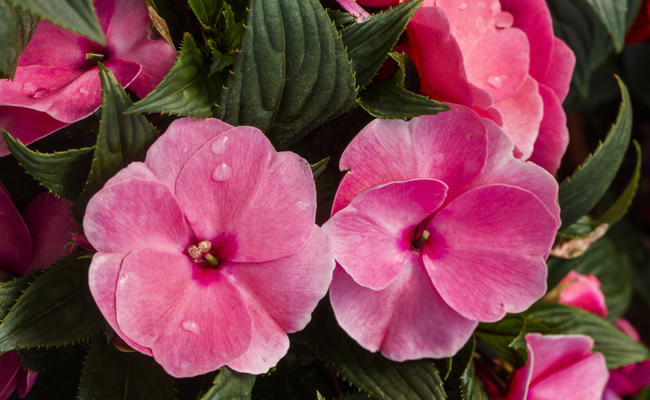
Genre Achimenes has only 25 species but many cultivars. Among the most common species you will find Achimenes coccinea syn. Achimenes erectawith many small bright red flowers, Achimenes gigantea with purple-red flowers with white eye on long stems that can measure 50cm, Achimenes longiflora with blue flowers with white throats but which comes in many hybrids such as ‘Ambroise Verschaffelt’ with veined white flowers punctuated with purple…
Also to be discovered among the cultivars Achimenes ‘Little Beauty’ with dark pink flowers and yellow eye 3cm in diameter, Achimenes ‘Paul Arnold’ with dark purple-blue flowers and a white throat nuanced with yellow and purple, Achimenes ‘Purple King’ with purple-red flowers with wrinkled edges, Achimenes ‘Yellow Beauty’ with primrose yellow flowers…