The codonanth (Codonanthe crassifolia) is an epiphytic perennial native to forested hills from Mexico to southern Brazil. Fearing the cold, needing a minimum of 15°C, it acts as an indoor plant in our latitudes, and more precisely almost a rare plant mainly prized by collectors.
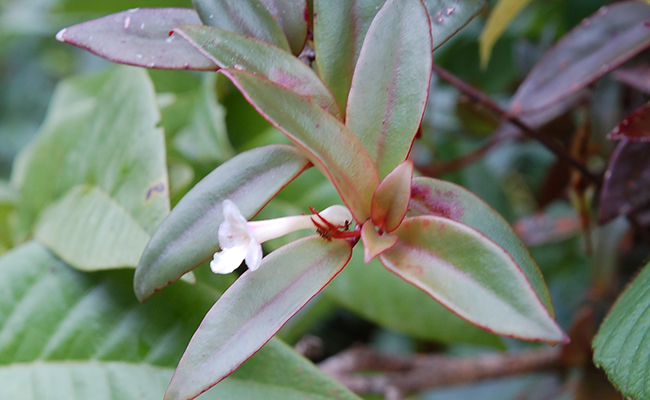
Its prostrate stems take root at the nodes but, when the plant grows in a pot, they take on a drooping habit which makes all their charm, being able to reach up to 1m in length. The evergreen, leathery leaves that grow there have an elliptical to oval shape, measure up to 8cm long, and are characterized by their dark green color, their waxy, glazed appearance.
From March to June, but almost all year round indoors, small white flowers with curved tube corollas develop with a wide yellow throat and lobes sometimes tinged with pink. They measure 2 to 3cm long and form axillary cymes of 1 to 4 flowers.
Fleshy, colored, pink, red or orange fruits sometimes form when the flowers are fertilized, which remains rarer indoors than in nature, but they reinforce the decorative asset of this pretty indoor plant.
- Family: Gesneriaceae
- Type: evergreen perennial
- Origin: Mexico, Brazil
- Color: white flowers
- Sowing: no
- Cutting: yes
- Planting: spring
- Flowering: spring, all year round
- Height: 0.60 to 1 m (spread 0.30-0.40 m)
Ideal soil and exposure for codonanthus
The codonanthe is grown in a light situation without direct sunlight, with high humidity, in a small container filled with a substrate composed of compost, coconut fiber and perlite, which is both light and well drained.
Date of cuttings and planting of codonanthe
It is in the spring or summer, ideally, that you will take stems to make them cuttings in a warm stew.
Like cuttings, planting can be done almost all year round. The division of the clump can also be practiced during repotting.
Repotting is not planned every year but rather every two years.
Council of maintenance and culture of the codonanthus
Watering should help keep the substrate cool but not excessively, taking care to space them out during the winter: to do this, just check that the surface has dried well between 2 waterings. If possible, use non-calcareous water. Vaporization is also very popular.
Adding fertilizer during the growth period will be beneficial.
Pruning should make it possible to remove unsightly, dried out stems, but also to promote branching, in the spring, to obtain a more compact plant.
Diseases, pests and parasites of codonanthe
Codonanthes are susceptible to attack by scale insects. Also beware of over-watering which can lead to root rot.
Location and favorable association of the codonanthe
It is a plant that is grown in a pot or hanging basket in a greenhouse or veranda, or of course as a hanging indoor plant in front of an east-facing window, without direct sunlight.
Recommended species and varieties of Codonanthe for planting in the garden
Genre Codonanthus has about ten species since some have been placed in another genus. The most common species remains Codonanthe crassifolia.
Codonanthe gracilis is another species but it is a shrub that has been used to create cultivars such as × Codonatanthus ‘Fiesta’ with pink flowers and × Codonatanthus ‘Aurora’ with cream flowers tinged with orange-pink.
(photo credit: By cpf1 / Christian Feuillet – CC BY-SA 2.0)