The horse chestnut vine (Tetrastigma voinierianum syn. Cissus voinieriana, Vitis voinieriana) is a vigorous vine native to Laos and Vietnam where it grows in tropical forests, but in our latitudes, it ranks among indoor plants since it needs a minimum of 10°C, and fears frost , although it can start again from the stump in the event of a brief frost around 0°C in dry soil.
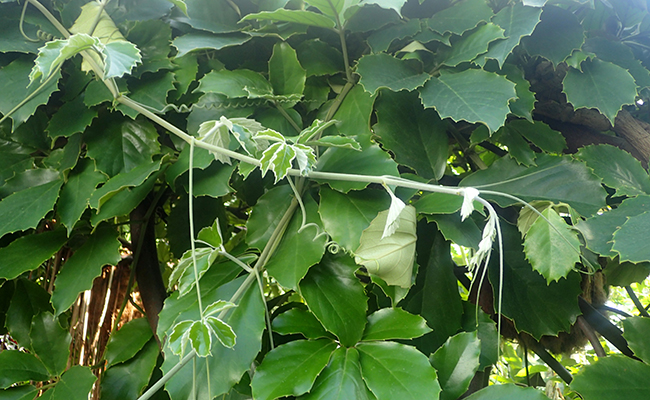
This vine is characterized by its long, stocky, brown, velvety tendrils, and its climbing or creeping habit, depending on the situation. Palmate leaves, persistent, can reach 45cm long, they are divided into 3 to 5 obovate leaflets, drawing almost a diamond, 10 to 25cm long, with toothed edge, of a shiny dark green with a downy golden brown reverse .
In its natural environment, the horse chestnut vine flowers in summer, which very rarely occurs indoors but can happen if the plant is grown outdoors. These are umbels or axillary bouquets 3 to 5cm in diameter, composed of small flowers with four yellowish green petals, nectariferous.
Flowering is followed by fruiting in the form of small red berries turning black when ripe: they look like grapes, are edible and have a sour taste.
The growth of Tetrastigma voinierianum is dazzling, including indoors where its stems can grow up to 2.5m per year!
- Family: Vitaceae
- Type: evergreen perennial
- Origin: Laos, Vietnam
- Colour: dark green leaves, coppery downy underside
- Sowing: yes
- Cutting: yes
- Planting: spring
- Flowering: summer (rare indoors)
- Height: up to 15 m (and 50 m in its natural environment)
Ideal soil and exposure for the horse chestnut vine
Tetrastigma voinierianum grows in a very bright situation without direct sun, in a substrate composed of loam, leaf mold and coconut fibers, so that it is light and well drained.
Needing good humidity, the horse chestnut vine will appreciate that its pot is placed on a bed of clay balls or gravel
Date of sowing, cutting and planting of the horse chestnut vine
It is in the spring that you will be able to start sowing, however it remains easier to practice cuttings of semi-augured stems in summer, smothered in the heat (20-25°C).
The alternative of layering can be considered, in the spring, because shoots can start from the nodes.
In pots, repotting is planned when the plant is cramped in its pot: it is advisable to intervene in winter or early spring.
Advice on maintenance and cultivation of the chestnut vine
During the growth period, regular waterings are necessary to keep the soil cool, then they will be more spaced out, once winter comes, leaving the substrate to dry out between two waterings.
Spring pruning aims to remove dried stems but also to rejuvenate the plant or limit its development. It can be quite severe but always occurs above a leaf.
Diseases, pests and parasites of the horse chestnut vine
The horse chestnut vine is not susceptible to disease but you have to be wary of attacks by parasites such as red spiders when the atmosphere is too hot and dry.
Location and favorable association of the horse chestnut vine
It is an indoor plant, generally, which is grown in a pot in a house with beautiful volumes allowing the twining horse chestnut vine to run as it pleases.
Outdoors, only gardens with mild winters can accommodate this vigorous tropical vine.
Recommended species and varieties of Tetrastigma for planting in the garden
Genre Tetrastigma has nearly a hundred species in total, but the horse chestnut vine (Tetrastigma voinierianum syn. Cissus voinieriana, Vitis voinieriana) will probably be the only one you will find on sale at nursery shops.
(photo credit: Krzysztof Ziarnek, Kenraiz, CC BY-SA 4.0 via Wikimedia Commons)