Some cats lick or eat their litter on an ad hoc or more habitual basis. While this behavior is not a concern in very young kittens, it should be taken seriously if it persists as it grows or if it appears suddenly in adult cats. But how to explain this astonishing phenomenon? In this file, we suggest you discover the possible causes of this behavior as well as the solutions to put in place to remedy it.
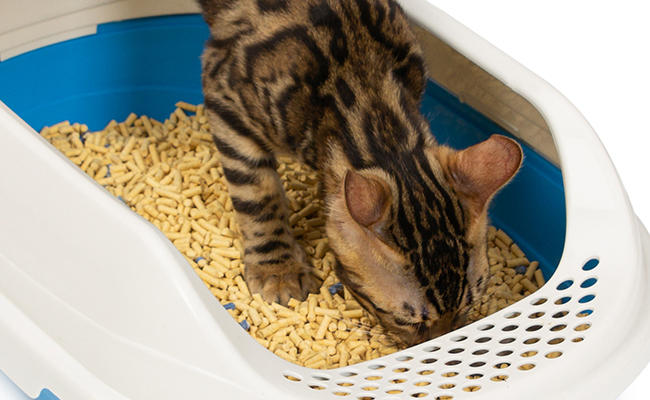
Why does a cat eat its litter?
There are several factors that may explain why a cat eats its litter.
Curiosity
When the kitten eats its litter, there is really no need to worry. Indeed, until the age of 12 weeks, the kitten is very curious and explores its environment by touch and smell, but also by taste. He can thus lick, nibble or chew on a whole heap of objects or materials that pass within his reach in order to discover them, just as a small child discovers the world through orality… by also putting a little of everything that handy to mouth!
The litter being an element of its environment, the kitten will naturally discover it, even if it means sometimes ingesting it. In itself, this is not alarming, but this habit should not take hold. Indeed, litter is not a food substance. It is therefore better to prevent the twink from consuming it too often, which is why it is better to help him to lose this bad habit very quickly.
What to do in this case?
If this is the case, simply change the litter first. If the novelty can tempt him again, it is above all a question of choosing a cat litter that will not be appetizing. Prefer an unappetizing litter such as wood pellets, or even recycled paper. Avoid small granulated litters, because they are too easy to swallow, as well as clumping litters, because your cat can ingest them and suffer from constipation or even intestinal obstruction.
If the small animal persists in wanting to eat its litter, remove the box as soon as it begins to be interested in it to help it break this bad habit. However, make the bin available to him as soon as he turns away so that he can use it to relieve himself. It is not a question of making him lose this good habit!
Boredom
Often underestimated by owners, boredom is a real enemy for cats. If it lacks occupation and stimulation in your absence, or if its environment is too restricted in relation to its needs or habits – an animal that has, for example, changed from an outdoor life to an indoor life or who has moved to a smaller accommodation – your cat may try to alleviate his boredom by eating his litter box. Admittedly, it’s not ideal, but it’s a way for him to keep himself busy… which he must lose at all costs!
What to do in this case?
Start by isolating the litter in order to keep it away from the dining area, the sleeping area and the play area of your little companion. The litter box must indeed remain accessible so that he can use it as he pleases, but it must not be too close to other activities. In this way, you teach your cat that the litter box is reserved for his needs, and you also prevent him from eventually getting into the habit of relieving himself elsewhere! Because indeed, if the kitten is not too observant, the adult cat risks defecating in another place, far from its bedding and its bowls. After all, would you enjoy eating in your toilet or sleeping there?
In addition, offer a whole bunch of occupations to your cat so that he plays and takes care of himself in your absence. Provide him with various toys, a cat tree, lots of objects likely to amuse him and which do not present a danger to his health. Vary the pleasures by taking out certain toys for a short period of time and then replacing them with others before playing them again, in order to avoid any fatigue. Also take the time to play with him whenever you can.
If he seems to be trying to occupy himself by eating his litter, take him out of the box and offer him a few moments to play to entertain him and divert him from this bad habit.
Too early weaning
It is common for kittens separated from their mother too early to develop behavioral problems. Some may decide to eat their litter or other inedible objects. For what ? Quite simply because the kitten learns from contact with its mother and its brothers and sisters to behave like a cat during its first weeks of life, during the socialization phase. If this phase is shortened by early weaning, the poorly weaned kitten can start to ingest or lick non-food substances, including litter.
What to do in this case?
This eating disorder is called pica and corresponds to the fact of ingesting non-food items. It is imperative to remain attentive in order to prevent it from continuing. If this is the case, it is important to consult the veterinarian and/or a feline behaviorist in order to put in place appropriate solutions.
Pica in adult cats
We have already mentioned it previously, but remember that pica is characterized by the fact of ingesting non-food substances. When seen in adult cats, it is usually linked to disorders such as nutrient deficiencies. In some cases, it may be a sign of a more serious condition.
What to do in this case?
Anyway, when the pica appears suddenly and the adult cat suddenly starts to ingest its litter, it is imperative to consult the veterinarian in order to find a suitable solution.
An iron deficiency
When the cat ingests a mineral litter, it is not always by chance. These litters indeed contain minerals such as magnesium, iron or even sodium. When the cat suffers from nutritional deficiency and anemia (lack of iron), it can swallow its litter in order to resolve the situation.
A cat suffering from anemia has pale, whitish or bluish gums and mucous membranes. This is a sign of a lack of hemoglobin. He is also tired, listless most of the time and he breathes while panting. A poor quality diet, low in iron, vitamins, fatty acids and trace elements promotes anemia.
What to do in this case?
It is important to rebalance the twink’s diet quickly and to offer him a well-balanced, quality diet. Also be sure to consult the veterinarian in order to offer your cat supplements adapted to his needs.
Do not underestimate anemia and avoid self-medication. In cats, anemia cannot be treated like in humans. Also, anemia can reveal another disease and be a symptom. This is particularly the case when the twink suffers from leucosis, leukemia, cat AIDS or hemobartonellosis. Kidney failure in older cats can also promote anemia.
My cat eats its litter: what are the risks?
This behavior in a kitten is nothing to worry about, provided it does not persist. The little kitty must be educated in contact with his mother, his breeder and his master. As soon as the animal licks or ingests its litter, it must be removed to make it understand that this behavior is not appropriate. It must then be entertained in order to divert its attention from the tray, but put it back in place as soon as possible so that the animal can relieve itself there as soon as it feels the need. If his litter box is no longer accessible to him, he may get into the habit of relieving himself elsewhere.
On the other hand, if this behavior appears suddenly, in the kitten or in the adult cat, the situation must alert its master. The twink may be ill and thus seek to relieve a nutritional or emotional deficiency, or even an underlying illness. It therefore becomes important to consult the veterinarian without delay in order to carry out an in-depth examination and put in place a suitable solution accordingly.
It should also be noted that the ingestion of large quantities of litter gravel can have significant consequences, which are even more serious in the case of clumping litter. Indeed, these gravel can cause constipation by blocking the stomach and the digestive tract, or even intestinal obstruction in the most severe cases. Finally, litter can be toxic, especially when it contains elements such as synthetic perfumes. If swallowed, there is a high risk of poisoning.
What to do to prevent a cat from eating its litter?
We have already mentioned a few solutions previously, but it seems important to us to offer some tips that will help prevent the cat from ingesting its litter.
Offer a litter that cannot be ingested easily, such as wood shavings or recycled paper. Avoid gravel which can be attractive. This can be effective in distracting the little kitten from a litter that it likes to ingest.
If the phenomenon persists or if this behavior occurs suddenly, it is imperative to consult the veterinarian. Indeed, only additional examinations will identify the cause of this behavior. The practitioner will thus be able to propose appropriate solutions depending on the origin of this disorder.