The funnel crossandra (Crossandra infundibuliformis syn. Crossandra undulifolia), also called wavy-leaved crossandra, is an erect subshrub native to forest edges in southern India and Sri Lanka. The lack of hardiness (12 to 15°C minimum) of this tropical to subtropical plant makes it a pretty indoor flowering plant, in our latitudes. However, it turns out to be capricious and rather demanding, which makes it more suitable for experienced amateurs.
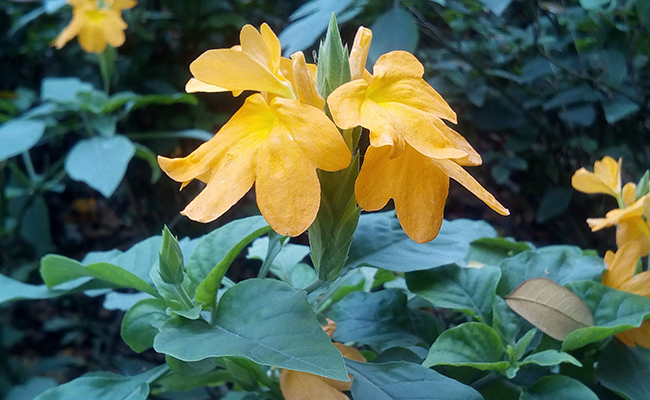
Its fine stems bear evergreen, glossy, oval to lanceolate leaves, 5 to 12cm long, medium green, with pointed tips and wavy edges.
Long-tube flowers bearing 5 fan-shaped lobes 1 to 3 cm in diameter bloom at the end of a conical axillary spike-shaped stalk 5 to 10 cm long, bearing downy bracts: the orange-yellow flowers Salmon-pink therefore bloom in turn all along the ear, from bottom to top, and fall off as they fade. Flowering can last a long time, from May to September, or even all year round, if the plant is maintained in suitable conditions.
Generally, the passage of winter is fatal to it because of the slightest excess of humidity, its fragility linked to drafts and confined atmospheres that it also fears. Generally, the crossandra does not last more than 2 or 3 years, even if you manage to tame its cultivation, because it becomes messy and more truly decorative.
- Family: Acanthaceae
- Type: flowering houseplant
- Origin: India
- Colour: orange-yellow to salmon-pink flowers
- Sowing: yes
- Cutting: yes
- Planting: spring
- Flowering: May to September
- Height: 35 to 45 cm (up to 1 m in its natural environment)
Ideal soil and exposure for crossandra
The crossandra is grown in a sunny, bright situation, without direct sunlight, sheltered from drafts in a substrate composed of potting soil and heather earth in equal parts, placed on a bed of gravel or clay balls in the bottom to facilitate drainage.
In winter, a temperature of 18°C suits him, and in summer, it should not exceed 21°C.
Date of sowing, cutting and repotting of crossandra
It is in March that you will sow the seeds at 15-16°C.
Cuttings provide better results with herbaceous stems taken from lateral branches in May, and placed in hot pots (20°C). It allows to renew the crossandra which loses its luster in a few years.
Repotting is planned in the spring, if necessary.
Board of maintenance and culture of the crossandra
Watering is done with non-calcareous water at room temperature, approximately once a week in summer so that the substrate does not dry out completely, and every 15 days in winter allowing the substrate to dry out a little more. Water flowing into the saucer must be removed.
Pinch off young shoots to encourage bushy development and remove spent flowers.
Diseases, pests and parasites of crossandra
The crossandra is sometimes sensitive to attacks by aphids, mealybugs, whiteflies.
Location and favorable association of the crossandra
It is a plant that is grown in a pot in front of a window facing west.
Recommended species and varieties of Crossandra for planting in the garden
Genre Crossandra counts about fifty species but you will mainly find the funnel-shaped crossandra (Crossandra infundibuliformis) and its few cultivars like ‘Mona Walhead’more compact, with intense salmon-pink flowers, ‘Lutea’ with bright yellow flowers, ‘Orange Marmalade’ with orange flowers…